Radiograph markup
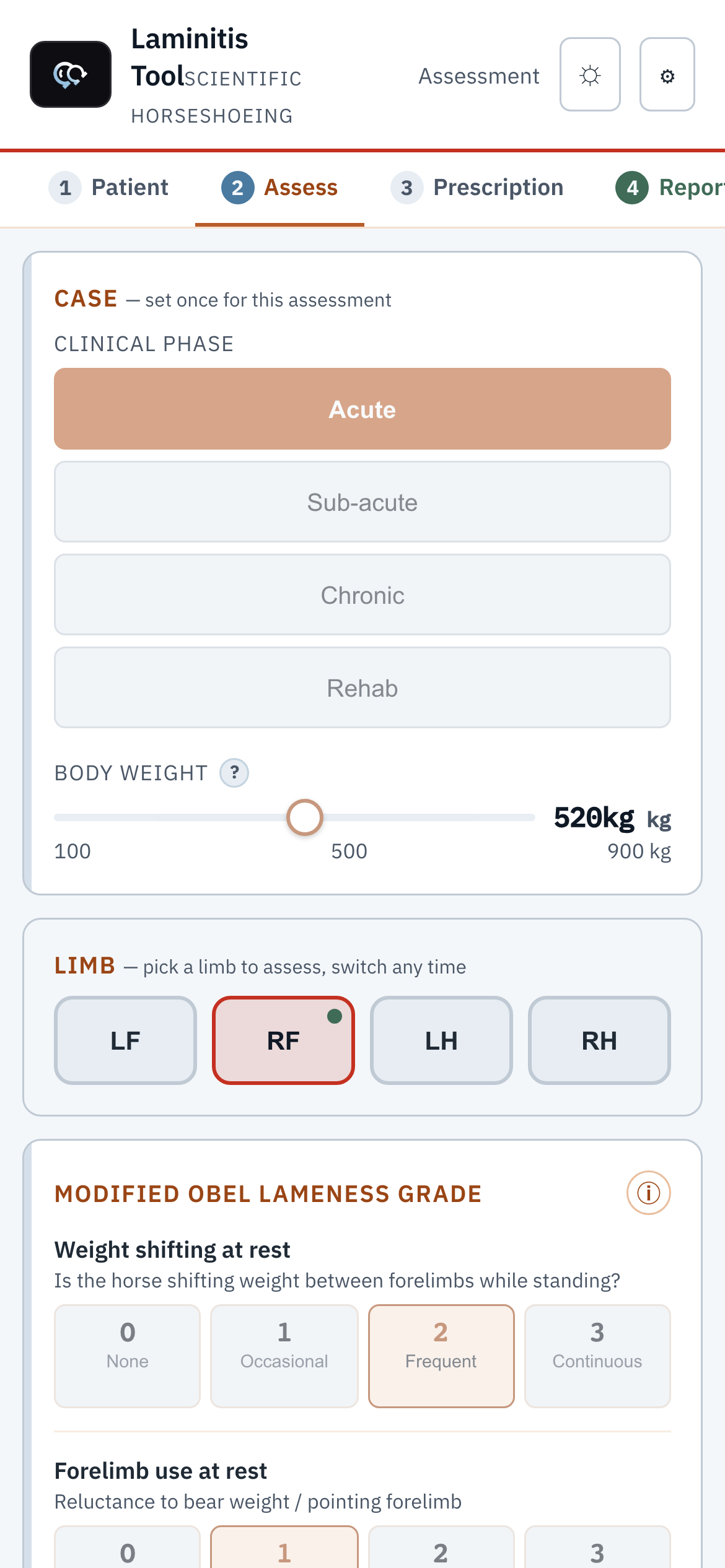
Tap landmarks directly on lateral and DP radiographs. Solar photographs too. Per-limb. The tool computes rotation, sole depth, sinking, palmar angle, and dorsal wall thickness from your taps — no manual algebra.
A clinical tool for qualified farriers and equine veterinary surgeons. It captures the measurements you already take and applies a compound palmar-angle and P3-rotation model to calculate a prescriptive heel-elevation protocol, returning a defensible multi-limb prescription in seconds. See the calculations.
Designed to replace the paper, calculator, and three open tabs you currently use to assess a laminitic case. Every output is justified by a documented biomechanical formula, not opinion.
Tap landmarks directly on lateral and DP radiographs. Solar photographs too. Per-limb. The tool computes rotation, sole depth, sinking, palmar angle, and dorsal wall thickness from your taps — no manual algebra.
Caldwell & Madden's compound-PA model is built in and calculates automatically from your radiograph markup. When PA exceeds 5°, the engine activates the secondary correction pathway — effective angle, excess PA and lamellar lever all derived live as you adjust inputs.
The heel-elevation model derives from tendon and laminar-tension formulae and the published work of O'Grady & Steward, combined with clinical geometric proportionality, to form the prescription baseline (see the calculations). The engine caps at 6 mm and surfaces every safety boundary, including tenotomy reduction mode for post-surgical rehab.
Capture all four limbs in one case. The output aggregates eligible limbs into a single prescription, surfaces cross-limb patterns (forelimb asymmetry, fore-dominant lameness), and prints a unified report.
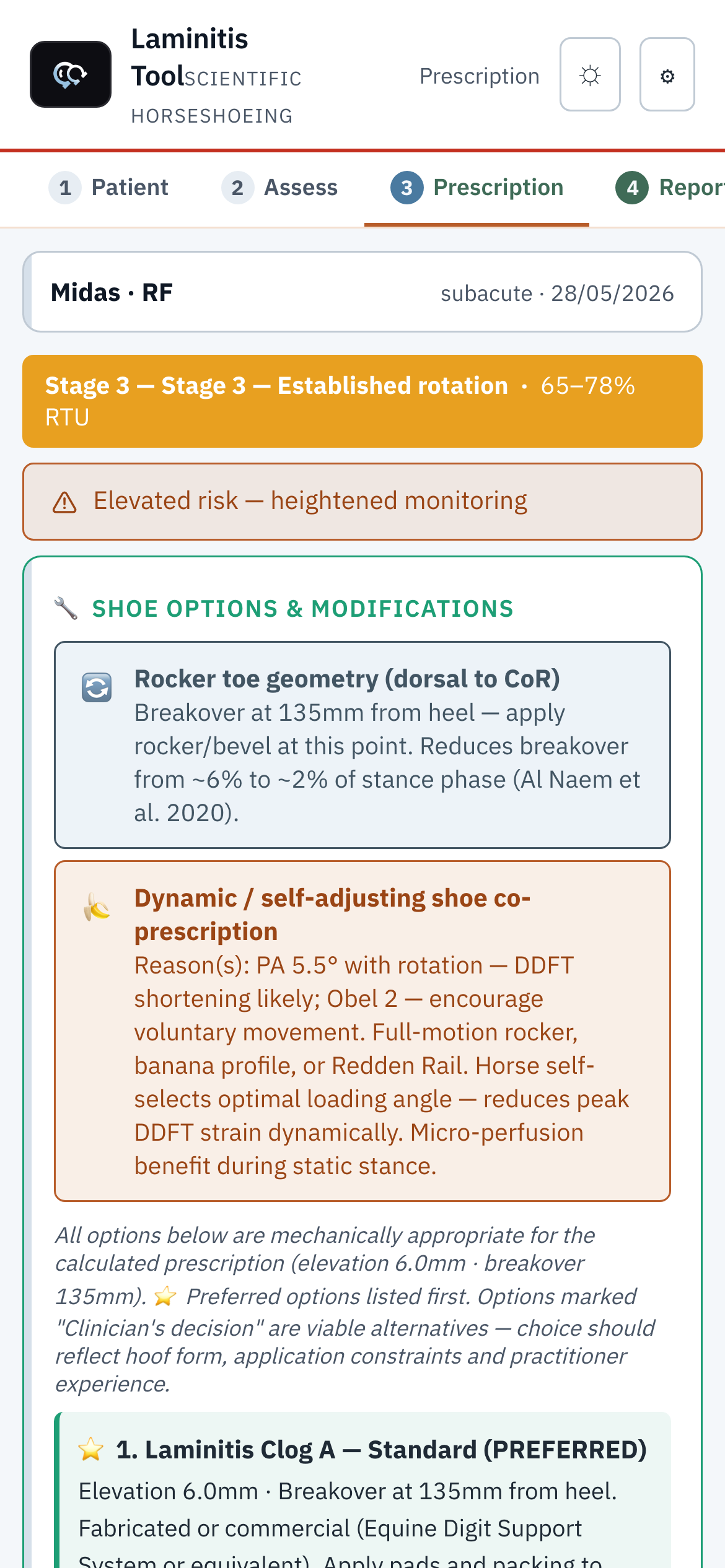
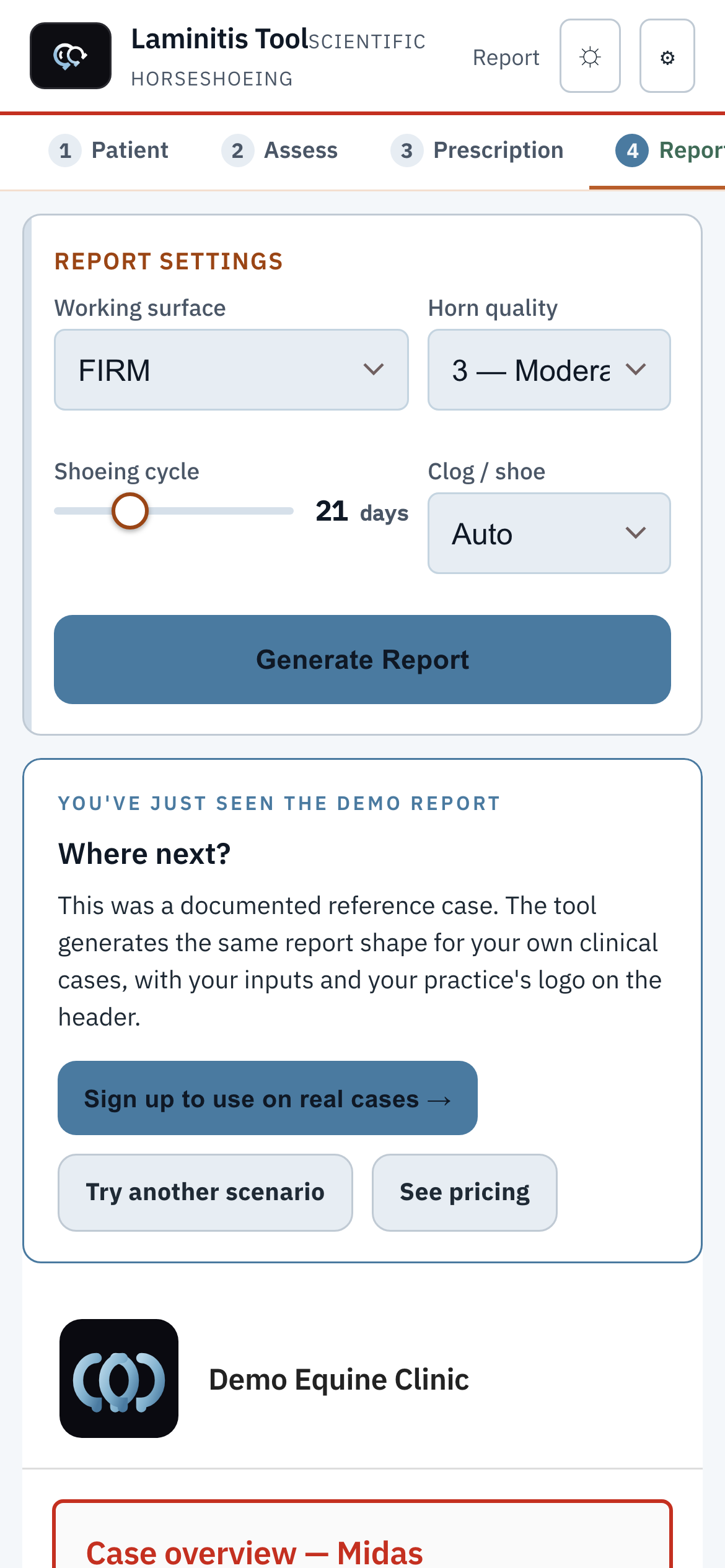
Auto-built farriery prescription card: breakover position, rim-pad spec, clog version, and the maximum Shore-A hardness for supportive materials — derived from hoof-wall and sole modulus-of-elasticity calculations, adjusted for horn quality, surface footing and clinical geometric proportionality. One-tap PDF report to share with the attending vet or file in case notes.
Install to home screen once. Works in barns, yards, and at the side of a horse with no signal. Cases sync back to the cloud when you reconnect. 60-day persistent sessions.
The tool is restricted to clinical use by qualified practitioners. Outputs are analytical, not diagnostic — clinical judgement remains with the attending veterinary surgeon.
Defensible prescriptions you can show to the attending vet or the horse owner, anchoring every recommendation in published biomechanical formulas instead of "the farrier just guessed". Plus automated case recordkeeping for professional liability and insurance: each report lists the recommendations to review at the next treatment cycle and records the outcome for comparative analysis.
Faster triage on laminitis cases — sinking risk, cast indication, sole emergency thresholds all surfaced automatically. Generates the prescription you would have asked the farrier to follow anyway.
The five engine-verified reference cases (Bella, Midas, Duchess, Apollo, Copperfield) cover the textbook presentations from prophylactic through critical sinking. Free to explore, no signup, at /demos.
The clinical workflow tracks the conversation a farrier or vet already has with a horse: declare intent, capture the patient, observe, measure, interpret, document. The tool removes the manual arithmetic and the cross-referencing, not the clinical judgement.
Confirm clinical use and the regulatory boundary. Done once per session.
15 secondsHorse identity, body weight, clinical phase, Modified Obel grade.
30 secondsPlug in the radiographic and hoof measurements. The tool calculates live.
2 to 5 minutesTap landmarks on the radiograph. Auto-fills the Assess values.
2 to 3 minutesF9, rim pad, Shore-A target, clog version. Live, all of it.
InstantOne-tap multi-limb PDF for case notes or vet handover.
10 secondsThe maths is the value, but the maths is invisible. This is what a documented Stage 1 case looks like before and after the tool's prescription is applied. Drag the handle, or tap left and right.
Reference scenario: Bella, Stage 1, no rotation. The schematic shows the model's prescribed mechanical environment versus the unintervened state. Load Bella into the live tool to see the full prescription.
Loading…
Every formula in the engine is byte-identical to Mark Caldwell's reference implementation, automatically verified on every release. The compound-PA model is from The Equine Foot Vols 1–2 (Caldwell & Madden, 2025). The F9 protocol is the AAEP-published work of Stephen O'Grady DVM and Andrew Steward (2007/2009).
"This is the tool I wished I'd had on my first laminitis case. It encodes every clinical judgement I make into a defensible workflow that any qualified farrier or vet can use the same way."

Try the five engine-verified scenarios free — no account, no payment. Sign up when you want to use the tool on a real case.